Problem
Prove that for any two real numbers and, we have
Chain of thought
You can see that looks reducible to a lower-degree polynomial. Let's assume and . This also reduces the RHS of the expression. So you get
How do you do this now? Also, note that and are now non-negative real numbers.
Now you can see that the expression consists of a cubic polynomial on the LHS. Let's define the polynomial . So we are required to prove that , where both .
Both the expressions in the LHS and RHS are multivariate polynomials in . But the LHS is multiplicative in nature, so it can be written as a multiplication of two univariate polynomials in and . The RHS cannot be written in a multiplicative format. So my question was: can you show something like for all ? Then we can show that . This was the core idea.
But we cannot do this if is not positive for . Let's check the sign of . For , , so . What happens for ? cannot go below , right? So gives . Hence . Now it becomes easier, as the inequality signs won't change.
More important is coming up with , and then the proof backwards. Let's think of an inequality that gives on the RHS, leaving the constant aside for a moment. What about Cauchy-Schwarz?
So if we take . This is cool, right? For the extra , we can write
So we have got . The next question therefore comes: is for all ? This reduces to showing that . Let's write it coherently on the LHS: . This looks factorizable! Do you see the factor? This is an opportunity. By factorization, you get
This is beautiful. and , so . Hence
Is 2 the best constant?
But is the optimum factor, or are there other optimum factors? What if I ask: what is the maximum value of such that
Of course . Let's redo the steps. will now be . Hence we ask if for all . This leads to the polynomial . So the question becomes: what is the largest possible? In other words, we want the maximum value of such that . So is the minimum value of for .
Look at . The discriminant of is , hence all the roots are real: one positive, one zero, and one negative. You can visualize the graph by the wavy curve method. It comes up from , crosses zero at the negative root, shoots up, takes a maximum, comes down and meets , pushes down for , takes a minimum, then goes up, crosses at the positive root, and goes to . We have to find that minimum on the positive -axis.
We can use calculus (although there are non-calculus ways to do it). gives , so the minimum happens at . Plugging it in, , so , and is the maximum value possible this way.
In fact, we didn't need calculus:
The curve comes from , crosses the axis at , rises, comes down, and kisses the -axis at . So if we take any , we bring the graph down, and at it becomes negative.
But is that the whole story? If you look at the picture below, you will see that even at , the curve stays above . So is not the largest possible .
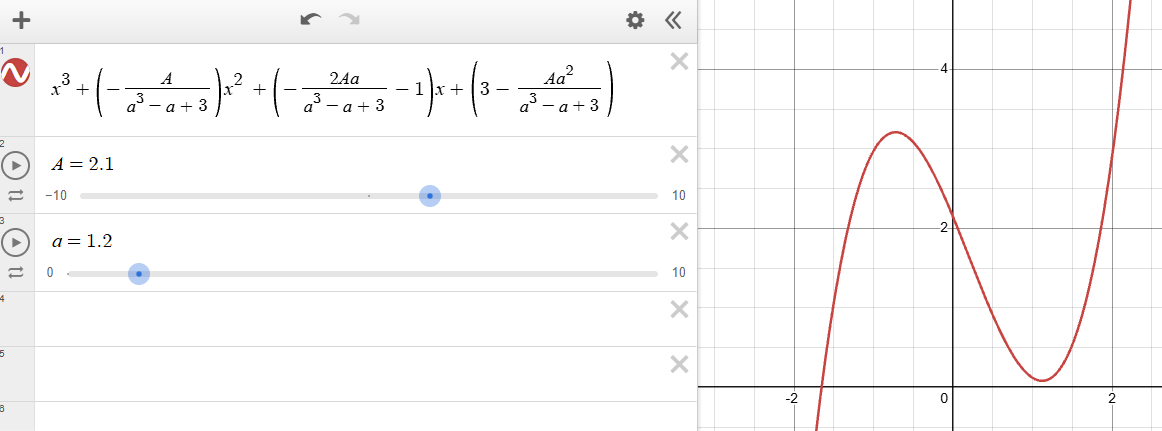
We now need more advanced machinery:
We will use multivariate calculus on and find its minimum. By calculation, you will find that . I will leave the multivariate critical point calculation to you. The calculation is not hard at all: you will end up finding quadratic roots and plugging them back into to get the maximum value of .